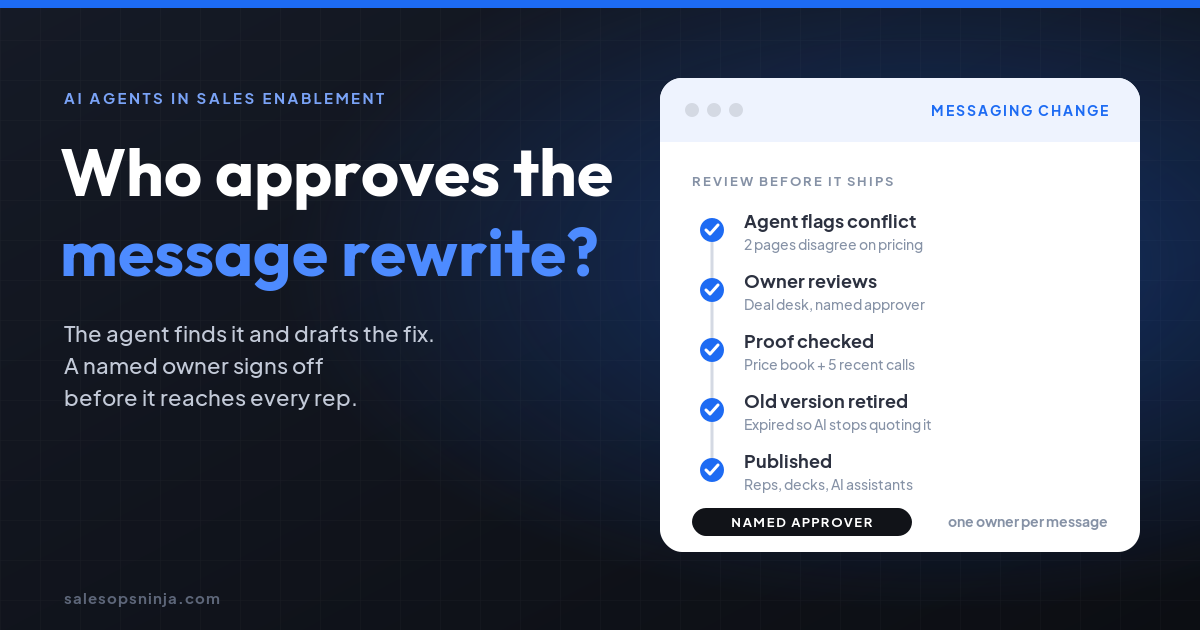
A named human owner for each message family approves every change before it goes live. Let the agent find outdated, conflicting, or missing messaging and draft the fix, but the person accountable for that message signs off, because one edit reaches every rep and every AI-written email at once.
I'm Michael Thomas Zajac, a sales operator in Hermosa Beach. I've spent a lot of hours listening to how reps actually talk to buyers, and I've learned the words in your library matter less than the words that leave a rep's mouth. That gap is about to get a lot faster to close, or a lot faster to widen.
What did Seismic just launch?
On October 13, 2026, at Seismic Shift, Seismic announced Library Agent alongside Deal Agent and a wider push to put its content inside the tools reps already use. Here is what the announcement says:
- Library Agent keeps the company knowledge "that sellers and AI rely on" current and governed.
- It identifies outdated, conflicting or missing messaging and helps teams manage metadata, content controls and expiration.
- It surfaces recommended changes for review and approval before updating content.
- The same content flows out through MCP into assistants like Claude, Microsoft 365 Copilot and Slack.
I like that review is built in. Most libraries rot quietly. A deck from two pricing changes ago still gets sent because nobody owns killing it. An agent that raises its hand and says "these two pages disagree" is doing work enablement teams rarely have time for.
Why does one edit matter more now?
Because the library is no longer just something reps browse. It is the source AI assistants pull from when they write the follow-up email, prep the call, or answer a buyer's question in Slack. A wrong claim used to show up in the few decks someone opened. Now it can show up in hundreds of drafted emails before lunch.
So "review and approval" is the whole control. The question is who does the reviewing, and what they check.
What was broken when I looked at real calls?
At Intertrust, I owned the Gong implementation for conversation intelligence, coaching, talk-track refinement, and deal inspection. What the calls showed was simple: the approved talk track and the talk track reps actually used were different documents. Some reps had found better language on their own. Others were repeating a claim that was no longer true.
The fix was not more content. It was deciding which version was right, based on what happened on calls, and making that the one everyone used. Meeting-to-opportunity conversion rose 20%.
That is the job a messaging approver does. An agent can spot the conflict. Only someone who knows which version wins deals, and which one is still accurate, should pick.
Who should approve a messaging change?
Give every message family one named owner:
- Product claims and capabilities: product marketing, with product confirming it is true today.
- Pricing, packaging, and discount language: deal desk or revenue operations.
- Competitive positioning: whoever owns competitive intel, checked against recent win and loss calls.
- Security, legal, and compliance statements: legal or security. No exceptions.
- Talk tracks and objection handling: enablement plus a frontline manager who hears the calls.
If a change touches two families, both owners approve. If nobody owns a family, the agent can flag it but nothing ships until someone does.
What should the approval checklist cover?
Before you approve an agent's recommended change, check:
- Is it true today? Confirm the claim against the product, price book, or contract, not against another page in the library.
- What is the proof? Every new or changed claim links to a source: a release note, a customer quote, a call clip.
- Does it match what wins on calls? Pull a few recent calls where reps used the old and new language.
- What does it replace? Retire or expire the old version so the AI cannot keep quoting it.
- Where does it flow? List the places it lands: decks, email templates, AI assistants, digital sales rooms.
- Who hears about it? Tell reps and managers what changed and why, in one line.
- When do we look again? Set an expiration or review date on the content itself.
What should you do Monday?
Export your library's top 25 most used assets and write a named owner next to each one. Anything without an owner goes on a list the agent can flag but not change. Then pick one talk track and compare it to five recent calls. If the library and the calls disagree, you just found your first approval decision.
If you're working through how coaching and AI fit together, I wrote about that in Can AI coaching replace your sales manager?.