A named person does, and you pick that person before the agent touches the number. Half of revenue teams cannot name one today. Write down who owns each AI-generated number, who owns its definition, and who approves a change before it reaches the board.
I'm Michael Thomas Zajac, a sales operator in Hermosa Beach. I have sat in the seat where the forecast had to hold up in front of leadership, and the fix was never a smarter model. It was knowing who was allowed to move the number, and who had to answer for it when it moved.
What did the 2026 State of AI in RevOps report find?
On October 8, 2026, Vasco CEO Guillaume Jacquet published what the 2026 State of AI in RevOps report means for CROs. RevStar and Vasco ran the peer survey across the RevStar community from August 24 to September 17, 2026.
The numbers that matter for anyone who owns a forecast:
- 97% of respondents are experimenting with AI or further along. Nobody gave AI output the highest trust rating. Only 26% trust it as much as a human analyst's work.
- Two-thirds have high trust in the numbers they take to the board or QBRs. Among them, 62% still say their CRM is not clean enough for an agent to act without human review.
- Forecasting is one of the use cases most often stalled or rolled back, at 31%, alongside CRM data hygiene at 36%.
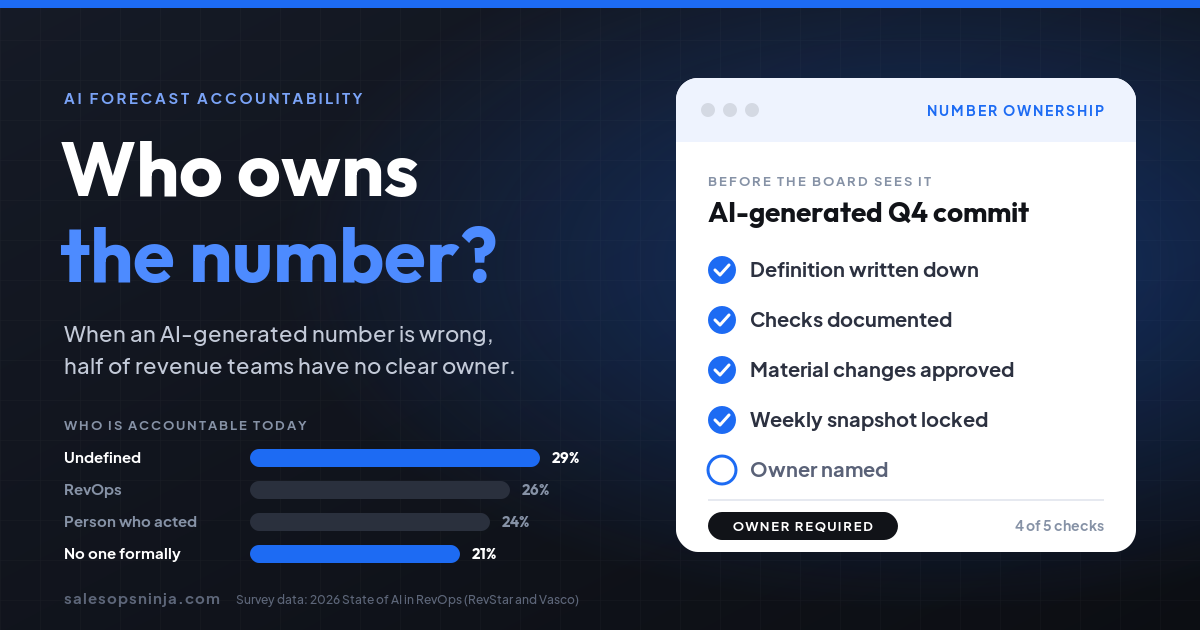
- Half cannot point to a clear owner when an AI-generated number is wrong. 29% have not defined accountability and 21% say nobody is formally accountable. At companies with $100M+ ARR, three in four gave one of those two answers.
That last one is the finding I would tape to the wall.
Why is the board number trusted today?
Because people check it. The report says it plainly: before a board meeting, someone knows which opportunities to question, which filters Finance uses, and which version of the number the CEO expects to see. That judgment is valuable, and it is usually undocumented.
An agent does not inherit that judgment. It sees the data. If the checks live in one person's head, the agent cannot reproduce them, and nobody notices until the number is already in the deck.
Even the hand-checked process leaks. 56% of respondents have found a number was wrong after it was presented or acted on at least occasionally, and another 21% find one frequently or constantly.
What breaks when nobody owns the number?
Look at how the accountability answers split: undefined (29%), RevOps (26%), the person who acted on it (24%), and no formal accountability (21%).
"The person who acted on it" is not ownership. That is blame after the fact. "RevOps" is closer, but it is a team, not a name. When the forecast misses in a board meeting, a team does not stand up and explain the variance. A person does.
The report also found that 62% trace their biggest source of distrust to meaning, not hygiene: no documented source of truth (28%), inconsistent metric definitions (21%), and tools that disagree (13%). Point an agent at a number with three definitions and it will not settle the argument. As the report puts it, it can only produce the disagreement faster.
How did I put an owner on the forecast?
On a Fortune 500 consulting engagement (NDA), the client already had weekly snapshots. Analysts were emailing spreadsheet comparisons around the org. Change detection was not the gap. What was missing was ownership: rep-level attribution, approval rules, and visibility into who moved what.
So I rebuilt the forecast around ownership. Opportunity data grouped by rep first, then rolled up to team. Weekly locked point-in-time snapshots. Explicit stage entry and exit gates. Approval and escalation workflows around material changes. The question changed from "what does the pipeline look like today?" to "what changed since last week, why did it change, who owns it, and what does that do to our commit?"
The breakthrough wasn't better visualization. We created a historical record of how the forecast moved, then put governance around who was allowed to move what, by how much, and when.
What did ownership produce?
Measured forecast accuracy went from 65% to 94% on that engagement. I measure accuracy as the absolute variance between weekly locked point-in-time forecast snapshots and eventual closed-won bookings, plus directional bias, cut by rep, segment, stage, forecast category, and snapshot week.
Intertrust is a separate story with a separate, rougher number. There, the SVP of Global Sales made me the pipeline "sheriff." I ran 1:1 deal and pipeline reviews with sellers, challenged their assumptions, and put ownership and approval rules around changes to stage, amount, timing, and commit. Forecast reliability moved from roughly 50% into the low 90s. That measurement was less formally controlled, so I always call it approximate.
Different companies, same lesson. The number got better when a named person owned every move.
If you are still deciding whether to turn AI forecasting on at all, start with the sequence in Should AI forecasting go live before you lock weekly snapshots? This post picks up after go-live: the agent is producing numbers, and someone has to own them.
What goes on the one-page accountability checklist?
Run this for every AI-generated number that reaches a forecast call, a QBR, or the board. One page per number.
- Name the number and the audience. "Q4 commit for the board deck," not "the forecast."
- Name the owner. One person, by name, who answers for whether it is right. Not "RevOps." Not "whoever acted on it."
- Write the definition and name its owner. Source, what counts, dates and filters, which deals are in or out. Name who owns that definition and who is allowed to change it.
- Write down the checks. List what the person who prepares the number checks today before it goes up. If it only lives in one head, the agent cannot repeat it.
- Set the approval line for material changes. Decide how much movement in amount, timing, stage, or commit needs a human to approve it before the agent's number replaces last week's.
- Lock a weekly snapshot and score it. Compare each locked snapshot to closed-won and track which way the misses lean. You cannot hold anyone accountable for a number that keeps changing under them.
- Track the checking time. The report suggests logging what the agent produced, what was wrong, what caught it, and how long the check took. That tells you whether the problem is the model, the data, or a definition nobody settled.
- Fill in the sentence. The report offers a simple test: "When [agent] produces [number] for [audience], [name] owns whether it's right, and [name] approves changes to the definition it uses." If you cannot fill in both names, the agent is not ready for that number.
The agent can produce the number. A person still has to own it. Name that person before the board meeting, not after the miss.