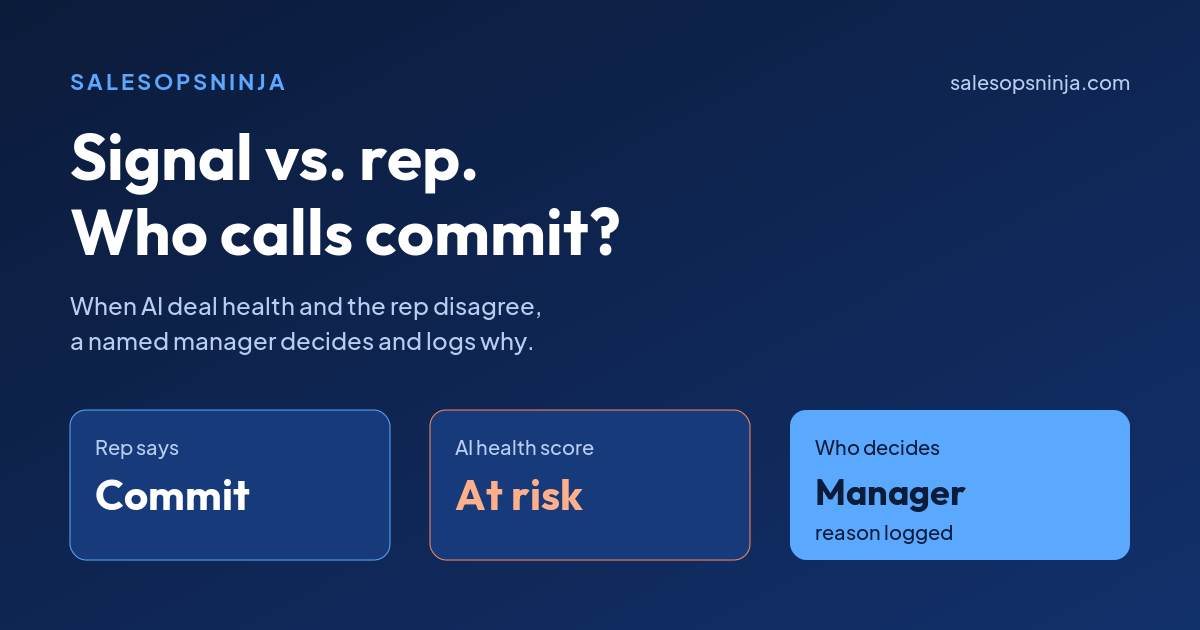
No, not on its own. The signal should win the argument about evidence, the rep should win the argument about context, and a named manager makes the call before the number moves. Write those rules down before the first commit call where they disagree.
I'm Michael Thomas Zajac, a sales operator in Hermosa Beach. I have run the weekly commit call when the CRM said one thing and the rep said another, and I have learned that the fight is never really about the deal. It's about who gets to decide what counts as true.
What is Salesloft Inspect, and why does it matter for commit calls?
Salesloft now markets Inspect as pipeline inspection that scores deal health from activity, engagement, and stage movement instead of what reps type into the CRM. Their pitch is direct: "Salesforce stores what reps tell it. Inspect validates it." The promise is to remove "the optimism bias and sandbagging that distort most forecasts."
That's a real problem worth solving. But the moment a tool scores deal health independently of the rep, your Tuesday commit call gets a new voice in the room. Sooner or later the score says at risk while the rep says commit. Somebody has to decide which one goes into the number.
What was broken when I inherited the forecast?
When I joined Intertrust as Director of Sales and BD, the commit forecast was muddy. Roughly 40 to 50% of what got called commit actually closed. Leadership couldn't plan around it, and reps had stopped believing the number meant anything.
The problem wasn't effort. Commit had no shared definition. One rep's commit was another rep's "I feel good about it." There were no evidence rules, so every call came down to who argued hardest.
What did we build to fix it?
We didn't buy a smarter model. We wrote down what commit meant, what evidence a deal needed to carry the label, and who could overrule the rep when the evidence wasn't there. Then we inspected against those rules every week, the same way, out loud.
By about day 90, the team could rely on a 90% commit-to-close rate. After that, the work moved to revenue velocity, because once you trust the number you can start asking how to make it move faster.
The lesson I carry from that: the inspection mattered less than the rules about what happens when inspection and the rep disagree.
When should the signal win?
The signal wins when the disagreement is about facts the system can see:
- No buyer activity in the window you agreed on. If the economic buyer hasn't engaged in two or three weeks and the close date is this quarter, the rep needs new evidence, not more confidence.
- Single-threaded on a deal that needs a committee. One champion can't sign alone. If the score flags it, the rep has to show the other names.
- Stage moved without the exit criteria. If a deal jumped to negotiation with no mutual plan or pricing sent, the stage is wrong, not the score.
- The close date has slipped more than once. Repeat slips are pattern evidence. Treat them that way.
When should the rep win?
The rep wins when the disagreement is about context the system can't see:
- The conversation moved off-platform. A text thread with the champion, a dinner, or a call from a personal phone won't show up as engagement. The rep logs it and names the evidence.
- The buyer's process is known and quiet by design. Legal and procurement weeks often look dead in the data. If the rep can name the step and the owner on the buyer side, that's context, not hope.
- The rep has a clean track record on calls like this one. History counts. A rep who has called commit accurately all year earns more benefit of the doubt than one who hasn't.
The rule is simple: the rep can overrule the signal with named evidence, never with a feeling.
Who makes the call?
Neither the tool nor the rep. A named frontline manager owns the commit label on every deal, and RevOps owns the rules the manager applies.
| Situation | Who decides | What gets logged |
|---|---|---|
| Signal and rep agree | Rep, confirmed by manager | Nothing extra |
| Signal says risk, rep has named evidence | Manager keeps commit | The evidence and who provided it |
| Signal says risk, rep has only confidence | Manager downgrades to best case | The reason for the downgrade |
| Rep says best case, signal says strong | Manager asks why, rep decides | The rep's reason |
| Rules themselves look wrong | RevOps, with sales leadership | The rule change and its effective date |
The log is the part most teams skip, and it's the part that makes you better. After a quarter you can see whether the signal or the reps were right more often, and tune the rules on facts instead of opinions.
Is this the same as fixing forecast accuracy?
Related, but not the same. Separately, on a temporary consulting sprint for a Fortune 500 team, forecast accuracy moved from 67% to 94%. That was a different problem with a different fix. The commit-call question is narrower: when a machine and a person disagree about one deal, who wins. If you don't answer that, a better score just creates a better argument.
If you're also sorting out who owns the board number when AI generates it, I wrote about that in Who owns the number when an AI agent gets the board forecast wrong?
What should you do Monday?
- Write a one-paragraph definition of commit. Include the evidence a deal must carry to earn the label.
- List your "signal wins" conditions. Keep it to four or five that your tool can actually see.
- List what counts as rep evidence. Named people, named steps, dated conversations.
- Name the decider. One manager per team owns the commit label. Not the tool, not the rep.
- Log every override for one quarter. Then review who was right and adjust the rules.
An AI inspector is a great witness. Just don't make it the judge.